What is best for 5 years from now Rebecca?

My executive coach Chris Yeh asked me a really great question a few weeks ago -- What is best for 5 years from now Rebecca? Assuming you can sleep at night with that course of action, it's the best path. Always.

It offers you staying power through the hard days, while also offering a real reality check when its time to move on.

And for me, at least, this question is much easier to answer than the more general 'What should I do?'

What it really is, is simply a way to shift your time horizon. That is power.

What is your best source of growth?

There are three key levers for growth in any business.

  1. Add new customers
  2. Get existing customers to buy more frequently
  3. Increase the average order value (dollars per transaction)

And within each of these levers, there are countless ways to achieve the end goals.

The real questions come down to:

  1. What kind of business do you want to be in?
  2. Where are your biggest opportunities?

If you want to run a boutique, high touch business, get your customers in the door more frequently, spending more money each time.

If you want to run a high volume, lower touch business, growing your new customers is going to be integral for business health.

If you're just starting out and don't have any customer, 100% of your focus should be on #1.

Get clear about what kind of business you want to be in. Get clear on which metric is your weakest and focus on that one first. It'll be the biggest bang for your buck!

BusinessRebecca Rapple
Supplying it all...

No single person nor any single aspect of your life can supply it all.

The joy. The meaning. The money. The support. The growth. The connection. The autonomy. Etc. etc.

Expecting a person -- or a job or a hobby or a pursuit -- to supply it all is setting yourself up for failure. (As unpopular as that assertion might be in some circles...)

Another strategy, as Chris Yeh calls it, is the portfolio strategy: make your life a portfolio of activities that, when added together provide you with everything that you're looking for.

This helps to take the pressure off of any single input without robbing you of anything that you need.

In other words -- don't put all of your eggs in one basket. Logical, if not popular.


The words don't matter that much...

The other day, I was talking with a friend about her business. She was a little stressed out about the quality of her sales copy and specifically feeling like not all of the words were "quite right".

Screw the words.

Okay, okay, yes, words are important... and copy can make a big difference, but I say focus on what really moves the needle.

Get clear on what message and feeling you want to convey.

Copy gets so much easier after that. Then every sentence, every word, can be evaluated by a simple litmus test: Is this creating the message and feeling I want?

It also means you can write from the heart. After all, the message & feeling IS the heart.

And here's the thing, getting to the message and the feeling isn't necessarily harder. It's just not the question we usually ask ourselves.

In the end, the words don't matter that much... but the feelings, they count for everything.

BusinessRebecca Rapple
Shift Your Time Horizon

People who know me well, know that I am all about the reframe. My Mom has even called it my super power.

Reframes help us look at the same situation from a different perspective -- and can blow our minds at how differently we feel about it.

Today I want to share the most consistently powerful reframe I know. It works for almost every situation.

Shift your time horizon.

Stop thinking about the next hour, day or year. Start thinking about a year from now, a decade from now or flash forward to your death bed.

Not a whole lot that stresses us out right now matters anymore, eh?

Which brings us to one of life's central paradoxes, as far as I can tell.

Little things don't matter that much in the scheme of things... But they create the big things -- so, really, they're everything!

What's Important Now?

I've been loving this question for the last 3 or 4 weeks. It comes from a wonderful story (found in the book Essentialism) of a high school Rugby coach who propelled his team to victory after victory with his "Win" philosophy.

That philosophy? An acronym for living and dying by the question "What's Important Now?"

There are three reasons that this philosophy is so powerful:

  1. It pulls you out of your brain and into the moment
  2. It crystalizes focus on just one thing
  3. It forces you to prioritize -- and act

Together, they completely change your state of mind & trajectory.

Even as I was getting a massage, I found my brain chattering and obsessing... I asked myself "What's important now?" Having the opportunity to relax, rejuvenate and take a break from my brain. And suddenly, things got quieter.

Other times I realize that I don't know what is important now, so I know that sitting down and prioritizing is exactly what I need to do.

And finally, I feel really good when I put myself at the top of that list, when me, or one of my goals, is what's important now. It amplifies the gratitude that I feel and my commitment to it.

All in all, use this question liberally. It's gold.

Positive Peer Pressure

If you look at your semi-close group of friends and don't feel some deep, internal pull to step up, to best yourself, to see what more you can do... you probably don't have the right group of friends. It's the kind of peer pressure you should seek. The positive peer pressure that raises your own expectations about yourself.

It's one of the easiest ways to manipulate yourself to be more.

And, yes, it is the root of the idiom "you are the average of the five people closest to you"

ExcellenceRebecca Rapple
Why quizzes are so addictive

Our society is into the quiz. I'm convinced its a main selling point of trashy magazines. Some of the highest converting opt-in offers online are quizzes. Hell, there are approximately 17 million different personality quizzes.

I'm hardly immune. I'm an ENTP and proud of it. Shenee's right, I'm a thought leader. And my fascination profile is the Avant-Garde.

But why?!?!

Because quizzes simplify the complexities of reality, they make concrete judgements when things feel fuzzy and, most of all, they make us feel seen.

When you simplify, concretize and make others feel seen, you win.

BusinessRebecca Rapple
When things feel like chaos...

The most common problem is that you don't know what the RIGHT things to do are. Your to-do list may be a million miles long... but you aren't confident that, even if they all go well, that it will be a success.

You want to feel in control and relaxed, knowing that you're moving in the right direction and that everything that needs to get done, is getting done.

BUT, no matter how hard you work, or what processes you put into place or even how many people you hire, the problem is still going to be there.

That challenge is getting a clear and potent strategy. There's no substitution for it.


The winning attitude? Curiosity.

Years ago, I read a book by Benjamin Zander, the famous Boston Philharmonic conductor. It's an easy read. I breezed through it on the beach. But, boy has it stayed with me. One of Ben's primary assertions is that the best response to almost any outcome is curiosity: ask, what can I learn from this situation.

It went amazingly well! I wonder why? Oh my god, I bombed. I wonder why? So and so let me down... I wonder why?

He goes so far as to have his players say -- "How fascinating!" -- as a way to immediately tap into curiosity without all of the fear and negative emotions that dampen creativity.

And that is the purpose of curiosity.

Curiosity is the mindset in which we invite creativity in to play. It invites us to imagine something new, something different, something better.

Creativity can't exist without curiosity.

Five Ways to Remember More of What You Read

I don't know about you, but it seems that a lot of what is read is in one ear, out the other. Given the amount of time that I invest in reading -- and how much I enjoy learning -- this is a travesty of epic proportions.

Over the last few months, I've been testing lots of ideas on how to remember more of what I read, here are my favorite five.

  1. Read Slower & Read Less This one was a little sad for me, as I pride myself on voracious reading habits. But it was probably the single most impactful change that I made. I got picker and I got slower.
  2. Take notes. Period. I've tried lots of ways of taking notes. What works for me, personally, is a notebook where I write down interesting ideas (sometimes with sources, sometimes my own ideas that came spontaneously). It's not overly organized or overly structured. This is what Ryan Holiday recommends, but its too structured for me. Notes are also how I decide when to stop reading short form. No notes = stop reading & unsubscribe.
  3. Re-Read Notes Each Sunday(-ish), I take time and review notes from a couple of weeks ago. It's amazing the amount this helps my memory recall and how many novel ideas I come away with. I find this activity to be very fun & gratifying.
  4. Summarize Each Chapter When reading a challenging book, for the purpose of learning, taking 10-15 minutes at the end of each chapter to summarize the major points (and counter points) makes a huge difference. Not only does it require actual understanding to synthesize, but at the end of the book, you have a handful of paragraph summaries that give you the high level overview. Double win.
  5. Send Authors Notes & Feedback You don't even have to mail it, simply thinking about the feedback I would offer an author helps me shift my perspective into a critical awareness of the books strengths and shortcomings. I've sent several.. and kept several. Both outcomes have been equally useful in helping me evaluate and remember the book.


LearningRebecca Rapple
The Not-So-Secret Equation

One of the most important tenants of our reality is my not-so-secret formula for success.

Event + Reaction = Outcome

Even though we can't always impact events, we can always change our reaction. This puts us in the driver's seat of our outcomes.

Let's be real: it can be intimidating to take responsibility for our outcomes.

But whether you decide to take ownership or not, the truth remains the same: you are responsible for your outcomes, and for the reality that they create. And while, yes, you can experience dramatic upside or downside based on events, life is long enough that it evens out in the end.

The secret is that when you decide to take responsibility, your ability to create the outcomes you desire increases dramatically.

ExcellenceRebecca Rapple
The Luck Formula

Think luck is random? No way. The formula for winning at luck is simple:

Quality of Content x Strength of Strategy x Quantity of Tries

Sure, you might hit the luck jackpot on the first try... but its much smarter to stack the odds in your favor by producing high quality content with strategic intent. Then you don't have to worry if it happens on try one, or try thirty, you know it's coming.

What does this mean in real life?

  1. Make your content the best available.
  2. Reverse engineer success (aka be strategic).
  3. Repeat.

If you aren't getting lucky, your problem is with your content or your strategy. Otherwise, its just a numbers game.

BusinessRebecca Rapple
Five Levers to Grow Your Business

While there are countless ways to grow your business, they all move they same five levers.

One of the best ways to spark creativity is to go through each of the levers and identify 10 ways to increase revenue using that strategy. Of course, you’ll have some bad ideas, but there are sure to be a few big winners in there too.

Here are the levers, you can:

  1. Increase the number of leads Growing the number of leads is one of the clearest, easiest ways to grow your business. The more people in the door, the more you’re going to sell.

    You can grow this lever in tons of ways. You can advertise, create opportunities for word of mouth, do super targeted outreach, get media coverage, write on other websites, use SEO, etc. etc. etc. The possibilities are endless.

  2. Increase the quality of leads Another way to make more sales is to not only increase the number of people walking through the door, but also to make them higher quality. Quality meaning that they are more likely to be your ideal customer.

    You can increase this by looking at which lead sources convert really well for you and do more of that. You can also change your channel strategies to better target your ideal audience. Perhaps shifting advertising to focus on people with the desired income range… or focus PR outreach to media outlets that have very clear connections with your products.

  3. Increase the rate of purchase (conversion rate) Now, once you get people in the door, it’s key to actually get them to pull our their wallet.

    There are literally countless ways to do this. You can improve the customer experience, offer amazing service, guarantee the lowest prices, discount, build relationships with your leads… the list goes on.

    But the best way to increase conversion rate is always the same. Have the exact product that your market wants.

  4. Increase the average order value So now that your leads have purchased, it’s time to help them buy more.

    Well considered upsells are a fantastic way to increase AOV. (Would you like to supersize that? Would you like leather seats in your car? Would you like one-on-one coaching with your course?) Upsells can be no-brainer purchases that improve the customer experience and increase average order value.

    The most comically overlooked way to increase AOV? Sell more expensive products. You can price test your current stuff, you can focus on selling your more expensive products or you expand to new, more expensive products.

  5. Increase the frequency of purchase Finally, now that we’ve gotten more leads and more people to buy more, we can focus on increasing order frequency.

    Amazon’s auto-re-purchase is a genius example of automating frequent purchase behaviors. Subscription products, like magazines or software, follow the same model.

    Other models include updating your product frequently, to trigger repurchases (like an iPhone or car), deepening their needs in your market, widening the market to include adjacent goods & services and planned convalescence.

    The best way? Sell great stuff and give them personalized opportunities for buy again.

Whew, after all of that, you should be bursting with ways that you can grow your business.

There are short term plays — send out an email about product X. And, there are long-term ideas — design a new, higher price point product.

My advice: find ways to optimize the micro while placing a few big strategic bets on the macro.

BusinessRebecca Rapple
Falling off the wagon

I'm currently traveling and, while the purpose of the trip has been successful, it's done a number on my core habits and, in turn, on my stable base. It's been hard to read. Hard to keep a sleep schedule. Hard to rejuvenate well.

When I go home tomorrow, it will be easy to keep slipping. Really easy.

But this is a case of the nearly's.

I (nearly) always read a lot. I (nearly) always sleep consistently. I (nearly) always put effort into rejuvenation.

The hard part is sticking to nearly and not letting a week of blown habits & travel cause me to fall all the way off the wagon.

ExcellenceRebecca Rapple
Timelessness

I'm a big fan of the idea to 'buy it for life'. Most people focus on durability as the key criteria for buy it for life. And, yes, the stuff needs to be durable... but the far harder, less common aspect is that you need to still love it in a decade, let alone a year.

How much stuff do you love today that you loved 15 years ago? 10 years ago?

For me, the list is short.

With that in mind, a key question needs to be: is it timeless? Can it survive changes in taste or in lifestyle?

When you find the rare gems where there is a clear yes, you know its a win.

(PS - All tattoos need to meet this criteria!)


BusinessRebecca Rapple
What to do when the low hanging fruit is gone...

You have two options when the low hanging fruit is gone. You can play a new game or you can strive to become THE best.

If you play a new game, its possible to combine skills to become world class (think funny writer + good artist = amazing cartoonist). Or, you become a jack of all trades, master of none.

If you strive to become the best, you know that the best reap disproportionate awards. But, you're playing a very hard, very competitive game. You may lose.

There isn't a right answer. Just a right path for you, right now.

Urgent vs Important

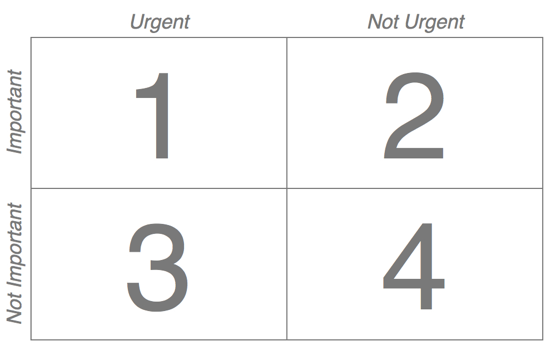
One of the best management tools that I have is the Urgent / Important grid, by Steven Covey.

covey-time-management-matrix.001.001

For the first few years in my career, I used this framework to make my to-do list everyday. At that point, I was working 80% or more in box one. My job title may as well have been corporate fire fighter.

Today, I use the framework to help my team focus their energy and to prevent them from becoming firefighters themselves.

I set goals with them around the amount of time spent in each quadrant and help them deal with requests that fall in groups 3 & 4.

Here's how it goes:

Quadrant One - Do it! Then ask, why did it get into Q1 in the first place? What can we do to prevent it from becoming urgent next time?

Quadrant Two - Spend as much time here as possible. This is high value, strategic work.

Quadrant Three - These are interruptions, limit them as much as possible! If there is an interdepartmental challenge (important to another group but not to you), prioritize as is appropriate or escalate.

Quadrant Four - Don't waste your time here.

I focus on spending more and more time in Quadrant two. For myself, today, I aim for 80% or more there.
Underrated Skill:Asking Great Questions

The best way to learn is to ask great questions. It doesn't matter if you are talking with an expert, reading a book or brainstorming alone -- focusing your effort by asking great questions is key.

Great questions focus your energy. They help you determine what is (and isn't) important and retain the information that matters.

Here are some great questions that work in all kinds of situations?

  1. What information do you need to make the decision?
  2. WHY are we (insert what you're doing)?
  3. What are the biggest assumptions that drive this option / person / view?
  4. What are the primary influences on this opinion / person / view?
  5. Why does this matter?
  6. What am I trying to convey? (message & feeling)
  7. Who are the stakeholders? Who does this impact?
  8. Who is protecting the status quo?
  9. How has this changed over the last (year / decade / month)?
  10. What is best for five years from now? (and change the time horizon)
  11. What's important NOW?
  12. Where have I seen these patterns before?
  13. What are the potential downsides? upsides? Most likely outcome?
  14. What is out of my control about this situation? What is in my control?
  15. What would help?


Feeling unworthy? Own it.

I have a voice that tells me that I'm unworthy. Sometimes it whispers... sometimes it shouts. It makes me want to hunker down, get small and invisible... or lash out and pretend I'm giant.

But this weekend, I found a new pathway with that voice.

I say yes, I am unworthy. How freakin' awesome is that?

I am unworthy so how lucky am I that I, my unworthy, tiny self, get to be here and get to experience this?!?

Unworthiness can be a path to gratitude and awe. And that feels wonderful.

ExcellenceRebecca Rapple