Posts in Leadership
Dashboards Should Measure Health

Requests for dashboards are almost always the same: I want to know what's going on.  That may be true, but that is not the purpose of a dashboard, and its not what you should really want.

Great dashboards measure the health of the leading indicators of the business.

To measure health effectively you need to:

  1. Get clear on what success looks like for your business
  2. Identify the leading indicators for success.
  3. Measure & track how reality compares with targets

With that information, you're armed to make powerful, strategic decisions in your business. If you just 'know what's going on', you're likely to miss out on the important early indicators.

Go fast: push Go Far: pull

I know how to push. How to talk negatively towards myself. How to fear failure more than anything. How to just make myself do it. I'm afraid I won't be as good / go as far / be as successful if I quit pushing.

The tough news is that I might be right in the short term: I won't be as successful if I don't push. I can probably lose more weight on a crazy 4-day crash (read: push) diet than I could on a 4 day "pull" diet.

But successful long term change comes from pulling. From honoring your deep desires. Those same diets over a year? No competition. Pull will knock the socks off the crazy push spree.

And for even more honesty, there are times that we need a break from the push.

Pulling can feel like cheating. But, its hardly always easy. The hardest thing about pulling is making sure that you actively remember what it is that you really want.

I want to feel light and energetic more than I want this donut. I want to have extra energy, so I want to go weight lift today. I want to feel accomplished tonight, so I want to send this uncomfortable email now!

Its not always easy, but it is simple & effective.

When you want to go fast, push... when you want to go far, pull.

I strive to play the long game in life: I aim to pull myself towards my goals.

I use my ability to push as a tool to sprint.

It's powerful (and smart) to use all the tools in your arsenal.
Sound Bite Culture

Sound bites are sexy. They are attention grabbing. They are clear and succinct. Trouble is? Our world isn't.

Our world is complicated, our challenges multi-faceted and our solutions, they are shades of grey.

And although they have their place in marketing, they should not have a place in our decision making. We seriously undermine our ability to understand and appreciate the many facets of the truth when what we hold true is a sound bite.

Remember, the sexy sound bite doesn't lead to the nuanced truth.

GOOD GOAL: More of your best

  The most fulfilling goals are almost always simple, but not easy -- and this one is no exception.

Do more of what you do best and most naturally --- and less of everything else.

Another way to state it would be to structure your work and your life around becoming  a better, truer version of yourself. Its all about spending the maximum time in your genius zone.

To do this successfully there are a number of leaps that need to be made. You need to:

  1. Develop and maintain the self awareness to know when you are at your best.
  2. Understand and communicate the value of working at your best (otherwise, you won't get paid for it).
  3. Earn the trust and negotiate buy in from your leadership that enables focus.
  4. Cultivate the support system that will not only take all the other stuff off of your plate, but even more importantly, actually accentuate and enhance your strengths with their own.
  5. Build the discipline to focus on your genius, without getting distracted by things that you are good at... or things that you are great at... or things you do quickly... or that one, little, high priority item that you can just squeeze in (its no big deal).

The biggest win? Turning your weakness into a solvable problem. Even a small step in that direction improves everything.

Underrated Skill: Self Management

One of, if not the single most important skill to thrive in a creative life (emotionally, intellectually, spiritually) is self management, or the internal ability to affect your mood, energy, productivity and attitude. Everyone can cultivate it.

Another way to think about it -- it's your ability to be a good boss to yourself. Your ability to direct motivate, focus, grow and sustain yourself. Pretty much the same list of core responsibilities of any manager!

Here are four great questions to start thinking about how you currently manage yourself... and how you can be a better boss for yourself!

  1. What is my #1 priority? Am I honoring it?
  2. What drives me to action?
  3. When do I handle setbacks effectively? When do they derail me?
  4. What replenishes me?

Even small improvements in self-management are 10x wins in life, so make them long term changes. Small & steady wins this race.

Working on the wrong things

  It's easy to be busy.

Easy to fill every moment of the day with things that need to be done.

It's extremely challenging to create a life where you constantly work on the right things -- the important stuff that isn't urgent.

You only find out what those things are when you slow down enough to step outside of yourself and your busy-ness. That is how strategy is uncovered.

What does this mean?

When you're overwhelmed, don't struggle to go faster, rather slow down, reflect & re-prioritize.

The truth about business strategy & packing to move

The truth is that it gets much, much worse before it starts to get better.

Overwhelm, confusion and mess sneak up on you. It feels like you had more clarity, cleanliness & safety before you started.

And THEN you have to start making hard decisions. Does this add to my business / life? Am I ever going to use this again? Is this who I really want to be?

It’s not comfortable and it is extremely tempting to give in. To just go back to what worked in the past… to just move everything… But that’s not what we came here to do.

With strategy & with moving, the discomfort needs to be moved through to get to somewhere better, somewhere with greater clarity and quality.

It’s always darkest before dawn.

What's Your Limiting Factor?

When things aren't working, we're often tempted to do more of what worked in the past. Many times, that's the best solution... but it fails miserably if the real issue is a bottle neck, a limiting factor.

How can you tell? Imagine 10x-ing your efforts, would that offer proportionate rewards? If not, you've got a bottleneck.

Your purpose is to identify & release the constraint.

Then repeat... and repeat... and repeat.

Put another way, improving your website conversion won't do much if your constraint is a lack of traffic... And getting more traffic won't make you any more money, if you have nothing to sell.

What is the limiting factor that is preventing you from achieving your goals? Focus on that.

What's Important Now?

I've been loving this question for the last 3 or 4 weeks. It comes from a wonderful story (found in the book Essentialism) of a high school Rugby coach who propelled his team to victory after victory with his "Win" philosophy.

That philosophy? An acronym for living and dying by the question "What's Important Now?"

There are three reasons that this philosophy is so powerful:

  1. It pulls you out of your brain and into the moment
  2. It crystalizes focus on just one thing
  3. It forces you to prioritize -- and act

Together, they completely change your state of mind & trajectory.

Even as I was getting a massage, I found my brain chattering and obsessing... I asked myself "What's important now?" Having the opportunity to relax, rejuvenate and take a break from my brain. And suddenly, things got quieter.

Other times I realize that I don't know what is important now, so I know that sitting down and prioritizing is exactly what I need to do.

And finally, I feel really good when I put myself at the top of that list, when me, or one of my goals, is what's important now. It amplifies the gratitude that I feel and my commitment to it.

All in all, use this question liberally. It's gold.

When things feel like chaos...

The most common problem is that you don't know what the RIGHT things to do are. Your to-do list may be a million miles long... but you aren't confident that, even if they all go well, that it will be a success.

You want to feel in control and relaxed, knowing that you're moving in the right direction and that everything that needs to get done, is getting done.

BUT, no matter how hard you work, or what processes you put into place or even how many people you hire, the problem is still going to be there.

That challenge is getting a clear and potent strategy. There's no substitution for it.


The winning attitude? Curiosity.

Years ago, I read a book by Benjamin Zander, the famous Boston Philharmonic conductor. It's an easy read. I breezed through it on the beach. But, boy has it stayed with me. One of Ben's primary assertions is that the best response to almost any outcome is curiosity: ask, what can I learn from this situation.

It went amazingly well! I wonder why? Oh my god, I bombed. I wonder why? So and so let me down... I wonder why?

He goes so far as to have his players say -- "How fascinating!" -- as a way to immediately tap into curiosity without all of the fear and negative emotions that dampen creativity.

And that is the purpose of curiosity.

Curiosity is the mindset in which we invite creativity in to play. It invites us to imagine something new, something different, something better.

Creativity can't exist without curiosity.

What to do when the low hanging fruit is gone...

You have two options when the low hanging fruit is gone. You can play a new game or you can strive to become THE best.

If you play a new game, its possible to combine skills to become world class (think funny writer + good artist = amazing cartoonist). Or, you become a jack of all trades, master of none.

If you strive to become the best, you know that the best reap disproportionate awards. But, you're playing a very hard, very competitive game. You may lose.

There isn't a right answer. Just a right path for you, right now.

Urgent vs Important

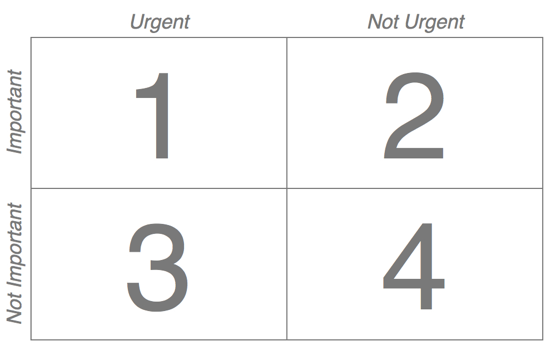
One of the best management tools that I have is the Urgent / Important grid, by Steven Covey.

covey-time-management-matrix.001.001

For the first few years in my career, I used this framework to make my to-do list everyday. At that point, I was working 80% or more in box one. My job title may as well have been corporate fire fighter.

Today, I use the framework to help my team focus their energy and to prevent them from becoming firefighters themselves.

I set goals with them around the amount of time spent in each quadrant and help them deal with requests that fall in groups 3 & 4.

Here's how it goes:

Quadrant One - Do it! Then ask, why did it get into Q1 in the first place? What can we do to prevent it from becoming urgent next time?

Quadrant Two - Spend as much time here as possible. This is high value, strategic work.

Quadrant Three - These are interruptions, limit them as much as possible! If there is an interdepartmental challenge (important to another group but not to you), prioritize as is appropriate or escalate.

Quadrant Four - Don't waste your time here.

I focus on spending more and more time in Quadrant two. For myself, today, I aim for 80% or more there.

Underrated Skill:Asking Great Questions

The best way to learn is to ask great questions. It doesn't matter if you are talking with an expert, reading a book or brainstorming alone -- focusing your effort by asking great questions is key.

Great questions focus your energy. They help you determine what is (and isn't) important and retain the information that matters.

Here are some great questions that work in all kinds of situations?

  1. What information do you need to make the decision?
  2. WHY are we (insert what you're doing)?
  3. What are the biggest assumptions that drive this option / person / view?
  4. What are the primary influences on this opinion / person / view?
  5. Why does this matter?
  6. What am I trying to convey? (message & feeling)
  7. Who are the stakeholders? Who does this impact?
  8. Who is protecting the status quo?
  9. How has this changed over the last (year / decade / month)?
  10. What is best for five years from now? (and change the time horizon)
  11. What's important NOW?
  12. Where have I seen these patterns before?
  13. What are the potential downsides? upsides? Most likely outcome?
  14. What is out of my control about this situation? What is in my control?
  15. What would help?


Be clear about your desires

We can't help you until we know what you want. Be clear, upfront and direct about it.

If we can't help you, we might know who can.

But we can't do anything, unless we know how to help.

(And, yes, you know what you want... even if its only the next baby step.)

LeadershipRebecca Rapple
The truth about short cuts

The truth about shortcuts is a lot like the fallacy of effortlessness. They don't exist -- at least, not in the way that they are advertised.

Short cuts absolutely exist, in terms that there are shorter & longer ways to get from point A to point B, but the fast lane to beat all of your competition easily & quickly, there's no such thing.

Shortcuts come from people who have discipline to zoom out and evaluate their market strategically and execute their vision exquisitely. Most people skip this vague and challenging task.

"Overnight successes" are almost always people who have valuable adjacent skills that they developed over the long term. These advantages are often invisible from the outside, but are the basis of quick success.

The seeming unbeatable leadership position came not from any single shortcut or action, but rather through hundreds or thousands of consistent decisions.

All in all, shortcuts come down to three skills

  1. Evaluating the system for ways to do things differently and better
  2. Evaluating yourself to identify adjacent value that you can offer
  3. Executing with discipline and excellence

Rather then search for the shortcut, hone these three skills, and you'll come out ahead -- in the short & long term.


It's rarely rocket science.

Most things just aren't that complicated. In fact, most things, get worse when they get complicated.

Running a successful company is much less about doing 5,000 different things, and much, much more about doing 10 key things 5,000 times (0ver & over & over again). It's all about optimizing the system.

The thing is that doing 10 key things 5,000 times takes a totally different skill set than coming up with the 5,000 ideas.

It requires action and determination and consistency. It requires grit and willpower. Honestly, it's less fun than brainstorming!

But that work ethic is where success comes from 99% of the time. It comes from the action, consistently optimized, not the idea.

After all, any action at all -- even stupid action -- trumps any idea, any day.

Action begets clarity

I fall into the trap just as much as everyone else...I want to think my way out of confusion and uncertainty.

But, by the time you get to the point that you realize that you are confused, thinking isn't going to cut it. It's time for action.

All you need to do to figure it out is the MINIMUM required to move forward (or sideways, or heck, even backwards!)

It might be a good time to ask my question for making hard decisions.

Action looks like a lot of things. It might be calling a trusted advisor or finding a YouTube tutorial or doing a small test... or saying screw it, let's go big, now! What your action looks like isn't important.

Action begets clarity, all you need to do is start moving.

Make your weakness a solvable problem

There is considerable debate over whether you should focus your energy on mitigating weaknesses or improving your strengths. Let's look at one example. You're an amazing designer who is horrible at writing and sales.

On one hand, you can mitigate your issues: take a class on writing effective emails and attend a sales training. Now, you are okay at writing & selling. Your ability to attract clients has probably doubled! This is a big win.

On the other hand, you can make your weakness a solvable problem. You can hire someone to do your sales and translate your words into effective communication. Your ability to attract clients has probably 10x'ed. This is a crazy huge win.

A third option (I am out of hands!), you could work for a agency where selling isn't part of your job and communication is largely handled by someone else. Another win!

Moral of the story: mitigating key weaknesses can lead to big wins, but the exponential wins come from framing your weakness as a solvable problem -- and then taking the steps to take it off your plate.

LeadershipRebecca Rapple